
Date: 22’nd December 2024 (Sunday)
Time: 9:30 AM to 1:00 PM
Venue:
VGLUG Foundation
SRIMAA PRESCHOOL (Gov Recognized)
Landmark: Opposite to BSNL Exchange
Villupuram 605602.
Minutes of meeting
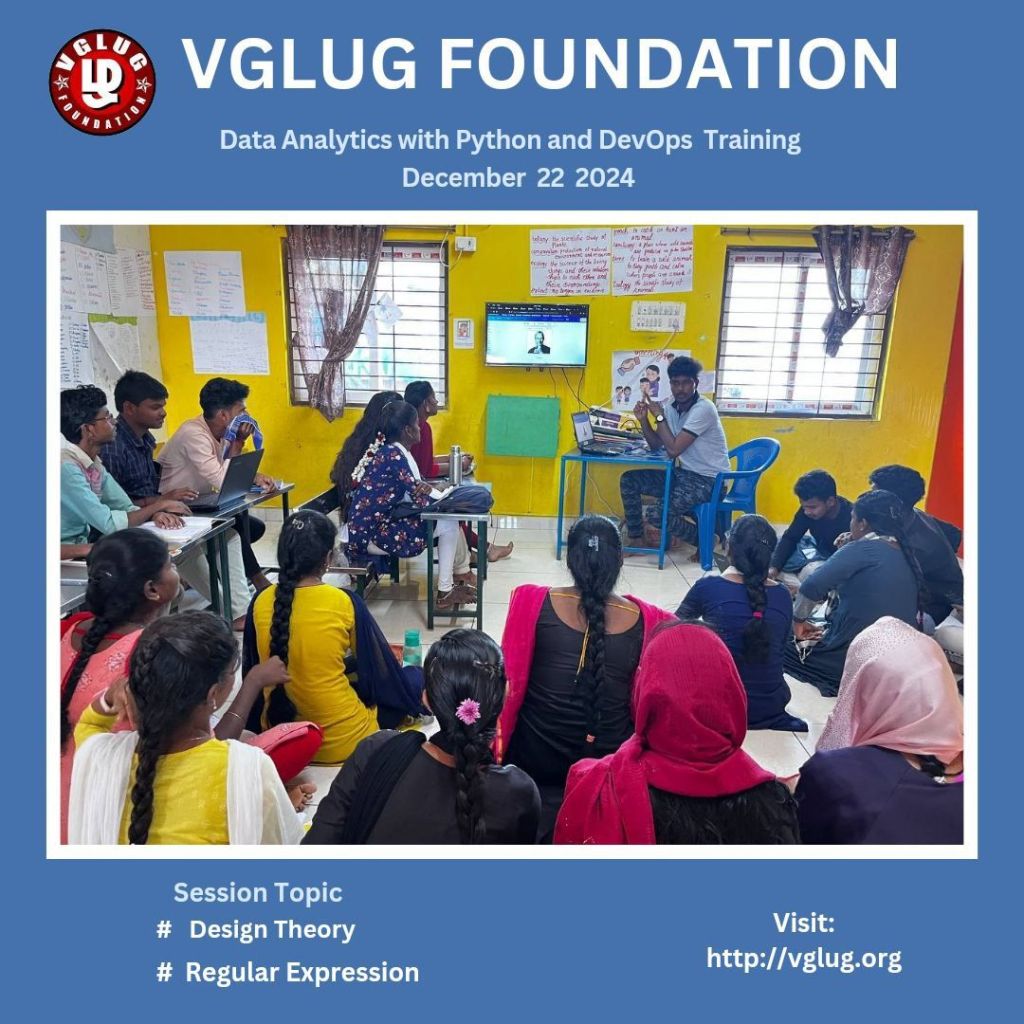
Data Analytics with Python Team 1(Arts & Science)
Topics:
session 1:
Regular expression – Vijayalakshmi
session 2:
Design theory – Bharathi
Regular Expression (Regex) in Python
Session handled by Vijayalakshmi, she is explained regular expression (regex) is a powerful tool for pattern matching and text processing in Python. The re module provides functions to work with regex efficiently.
Basic Components of Regex
Special Characters
\d: Matches any digit (0-9).
\w: Matches any word character (letters, digits, underscore).
\s: Matches any whitespace.
Quantifiers
*: Matches 0 or more occurrences.
+: Matches 1 or more occurrences.
?: Matches 0 or 1 occurrence.
Anchors
^: Matches the beginning of a string.
$: Matches the end of a string.
Common Functions
re.match(): Matches a pattern at the beginning of the string.
re.search(): Searches for a pattern anywhere in the string.
re.findall(): Finds all occurrences of a pattern.
re.sub(): Replaces matches with a specified string
Design Theory
Session taken by Bharathi, he is explained
Design theory focuses on principles and methodologies to create effective and efficient systems, products, or solutions. It integrates creativity, functionality, and user needs to achieve optimal results.
Key Concepts:
*Form and Function
Balancing aesthetics and usability.
*Consistency
Ensuring uniform design across elements for better user experience.
*Hierarchy
Prioritizing elements based on their importance.
*Alignment
Maintaining proper arrangement for clarity and organization.
*Feedback
Providing users with responses for their actions.
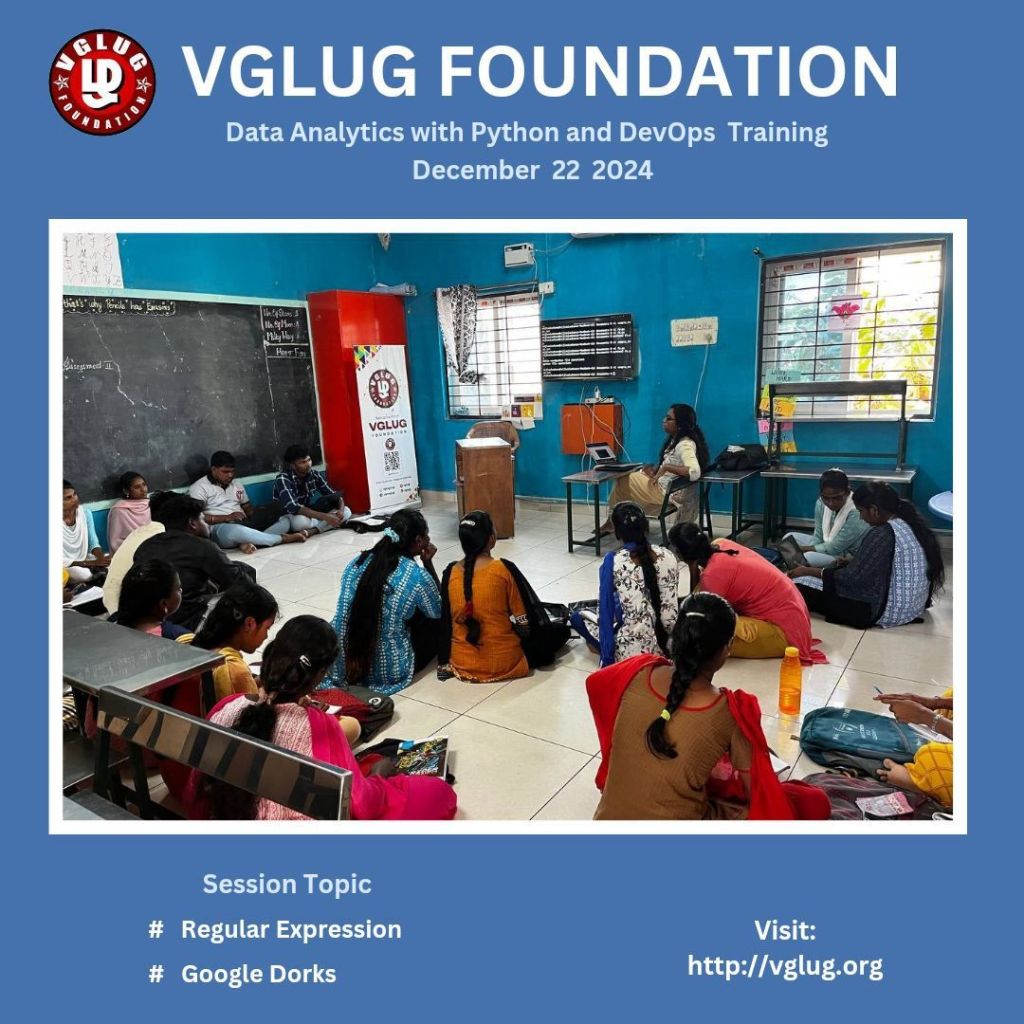
Data Analytics with Python Team 2(Arts & Science)
Topics:
session 1:
Regular expression – Vijayalakshmi
session 2:
Google dorks – Loganathan
Regular Expression (Regex) in Python
Session handled by Vijayalakshmi, she is explained
regular expression (regex) is a powerful tool for pattern matching and text processing in Python. The re module provides functions to work with regex efficiently.
Basic Components of Regex
Special Characters
\d: Matches any digit (0-9).
\w: Matches any word character (letters, digits, underscore).
\s: Matches any whitespace.
Quantifiers
*: Matches 0 or more occurrences.
+: Matches 1 or more occurrences.
?: Matches 0 or 1 occurrence.
Anchors
^: Matches the beginning of a string.
$: Matches the end of a string.
Common Functions
re.match(): Matches a pattern at the beginning of the string.
re.search(): Searches for a pattern anywhere in the string.
re.findall(): Finds all occurrences of a pattern.
re.sub(): Replaces matches with a specified string
Google Dorking
Loganathan has handled this session. He is explained that Regular Expressions (Regex) are powerful tools in programming used for pattern matching and text processing. They provide a concise and flexible way to identify strings of interest, making them indispensable in problem-solving scenarios such as validation, parsing, and data manipulation.
Data Analytics with Python Team 1(Engineering)
Topics:
session 1:
Database configuration & Problem solving – Deepak
session 2:
Open Hardware – Dilip
Database Configuration
Session taken by Deepak
Database configuration involves setting up and optimizing a database to ensure efficient data storage, retrieval, and management. Proper configuration is essential for performance, scalability, and security.
Open Hardware and its application
Dilip has handled this session. He explained Open hardware is transforming industries by promoting accessibility, collaboration, and innovation. From education to healthcare, its applications are vast and impactful. By embracing open hardware, we can build a more inclusive and sustainable technological future.
- Applications of Open Hardware
- Education and Research
- Healthcare
- Agriculture
- Sustainable Development
- IoT and Smart Devices
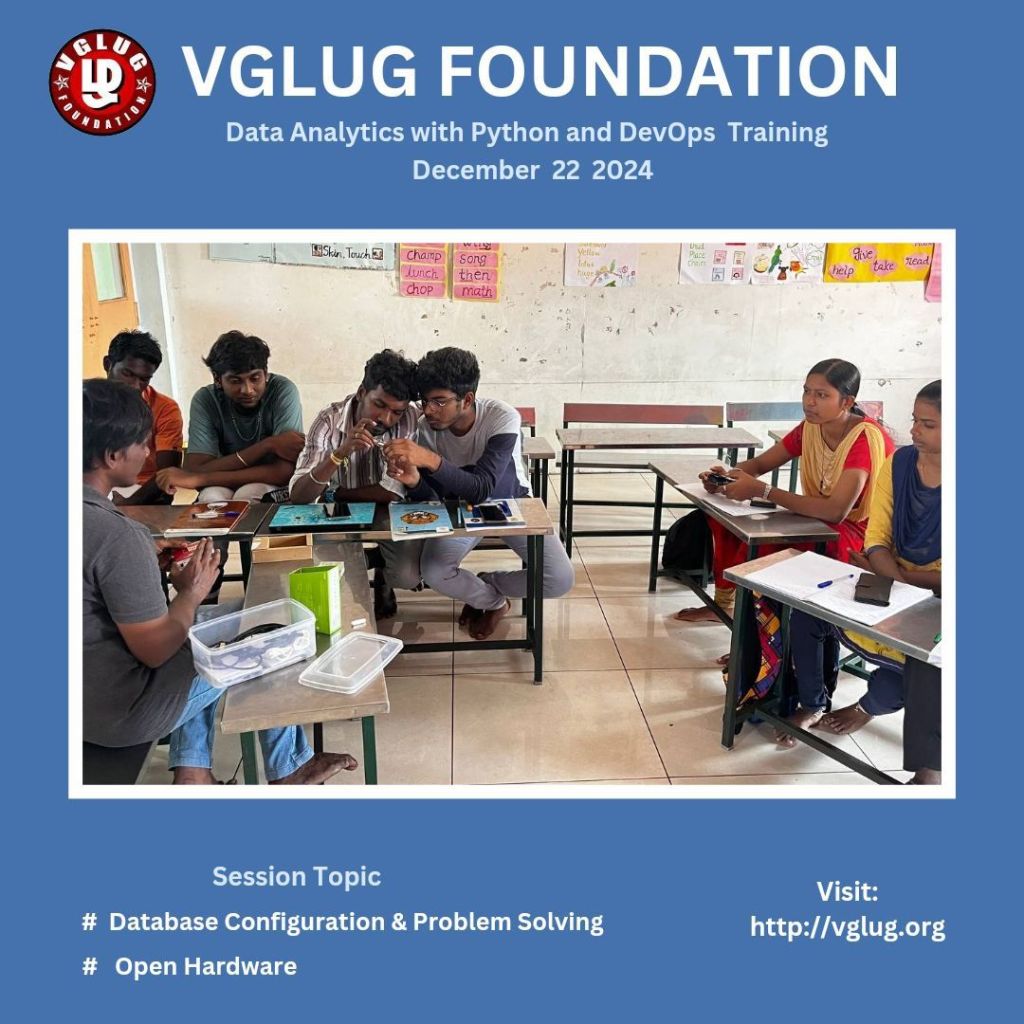
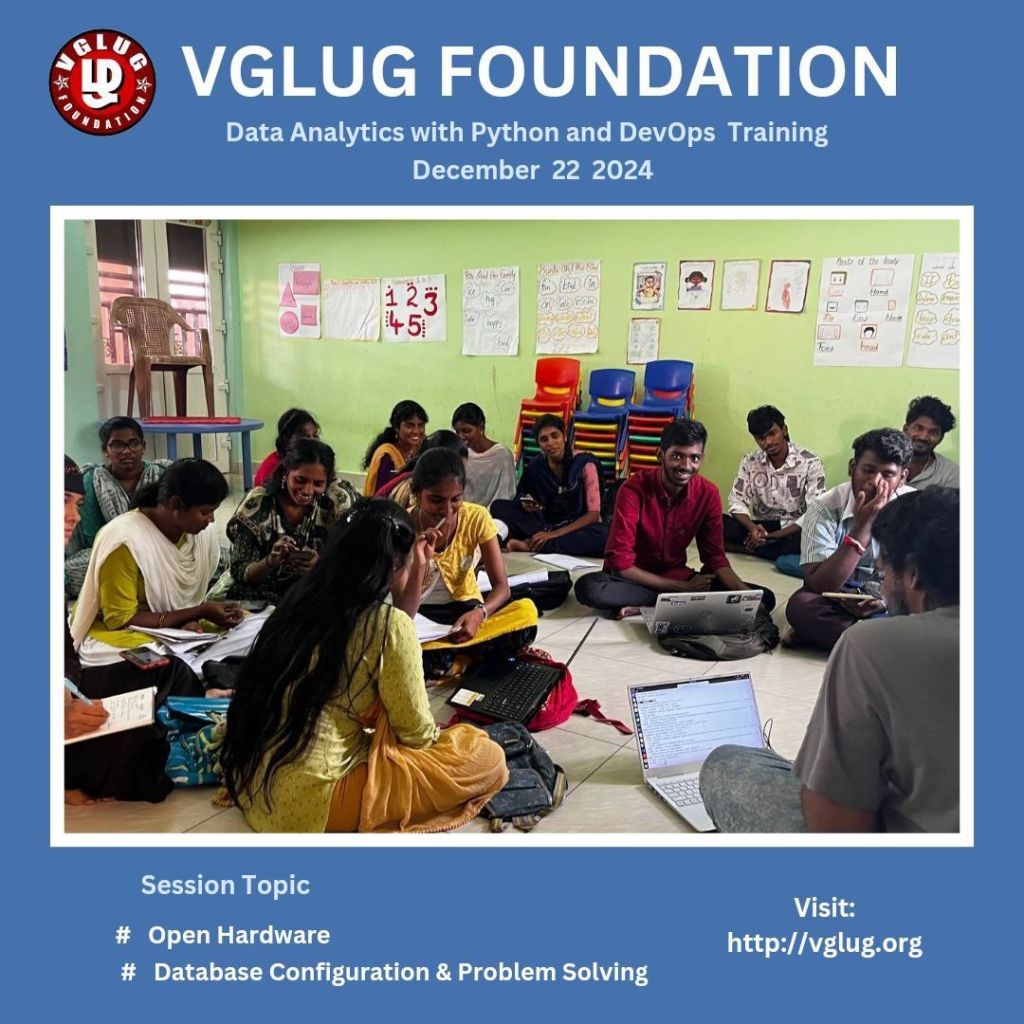
Data Analytics with Python Team 2(Engineering)
Topics:
session 1:
Open Hardware – Dilip
session 2:
Database configuration & Problem solving – Deepak
Open Hardware – Dilip
Dilip has handled this session. He explained Open hardware is transforming industries by promoting accessibility, collaboration, and innovation. From education to healthcare, its applications are vast and impactful. By embracing open hardware, we can build a more inclusive and sustainable technological future.
- Applications of Open Hardware
- Education and Research
- Healthcare
- Agriculture
- Sustainable Development
- IoT and Smart Devices
Database configuration & Problem solving – Deepak
Session taken by Deepak
Database configuration involves setting up and optimizing a database to ensure efficient data storage, retrieval, and management. Proper configuration is essential for performance, scalability, and security.
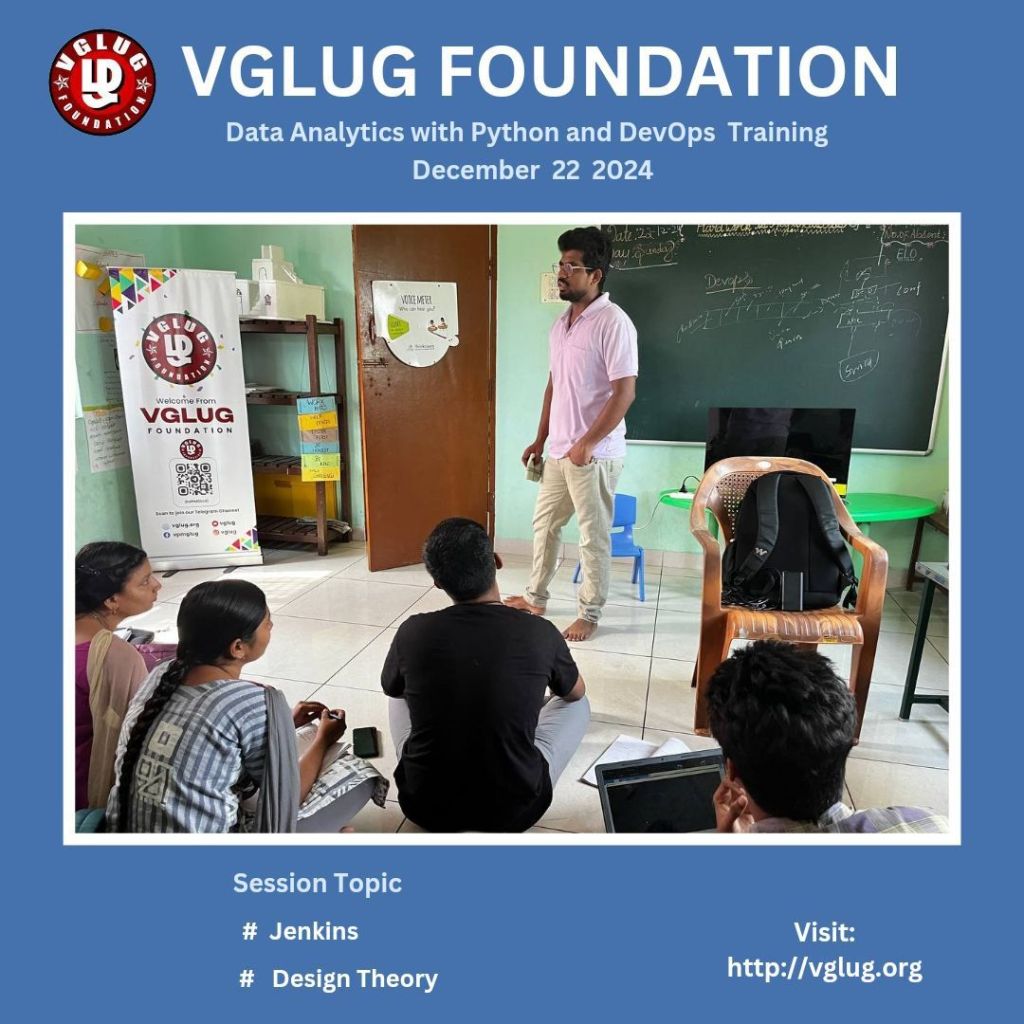
Devops
Topics:
session 1:
Jenkins – Loganathan
session 2:
Design theory – Bharathi
Loganathan has handled this session. He is explained Jenkins is an open-source automation server widely used for continuous integration and continuous delivery (CI/CD) in software development. It helps developers automate various stages of the development lifecycle, such as building, testing, and deploying code.
Key Features:
• Plugins: Jenkins supports over 1,800 plugins, enabling integration with various tools like Git, Maven, Docker, and more.
• Pipeline Support: Jenkins allows users to define complex workflows as code using its pipeline feature, which can be written in Groovy.
• Extensibility: It can be extended to support virtually any tool or process through plugins.
Distributed Builds: Jenkins can distribute workloads across multiple machines to optimize performance.
Web Interface: It provides a simple web interface for easy management and monitoring of jobs.
Design Theory
Session taken by Bharathi
Design theory focuses on principles and methodologies to create effective and efficient systems, products, or solutions. It integrates creativity, functionality, and user needs to achieve optimal results.
Key Concepts:
Form and Function
Balancing aesthetics and usability.
Consistency
Ensuring uniform design across elements for better user experience.
Hierarchy
Prioritizing elements based on their importance.
Alignment
Maintaining proper arrangement for clarity and organization.
Feedback
Providing users with responses for their actions.
Here, we attached tbe meetup clicks,
Arts team1
Arts Team2
Engineering Team2
Devops Team
Thanks To,
1.Vijayalakshmi
2.Loganathan
3.Dilip
4.Bharathi
5.Deepak
6.Kowsalya

 VGLUG Foundation