
VGLUG is dedicated to empowering rural college students through technology education.
As part of this initiative, we conduct weekly training sessions on Python With GenAI and DevSecOps..
Due to the large number of participants, the training is organized into six teams:
- Python & GenAI – Linus Torvalds(Team 1) & Grace Hopper(Team 2): Assigned to Engineering students
- Python & GenAI – Richard Stallman(Team 1) & Aron Swatz (Team 2): Assigned to Arts and Science students
- DevSecOps – Ada Lovelace (Arts) & Bob Thomas (Engg): Comprising both Engineering and Arts students
These sessions focus on practical knowledge of Python, GenAI, DevSecOps, free and open-source tools, and also include social awareness and community engagement activities.
Python With GenAI Training – 8’th Week Recap
Date: 20’th July 2025 (Sunday)
Time: 9:30 AM to 1:00 PM
Venue:
VGLUG Foundation
SRIMAA PRESCHOOL
Landmark: Opposite to BSNL Exchange
Villupuram 605602
Minutes of the Meeting
Python With GenAI – Richard Stallman and Aron Swatz(Arts) :
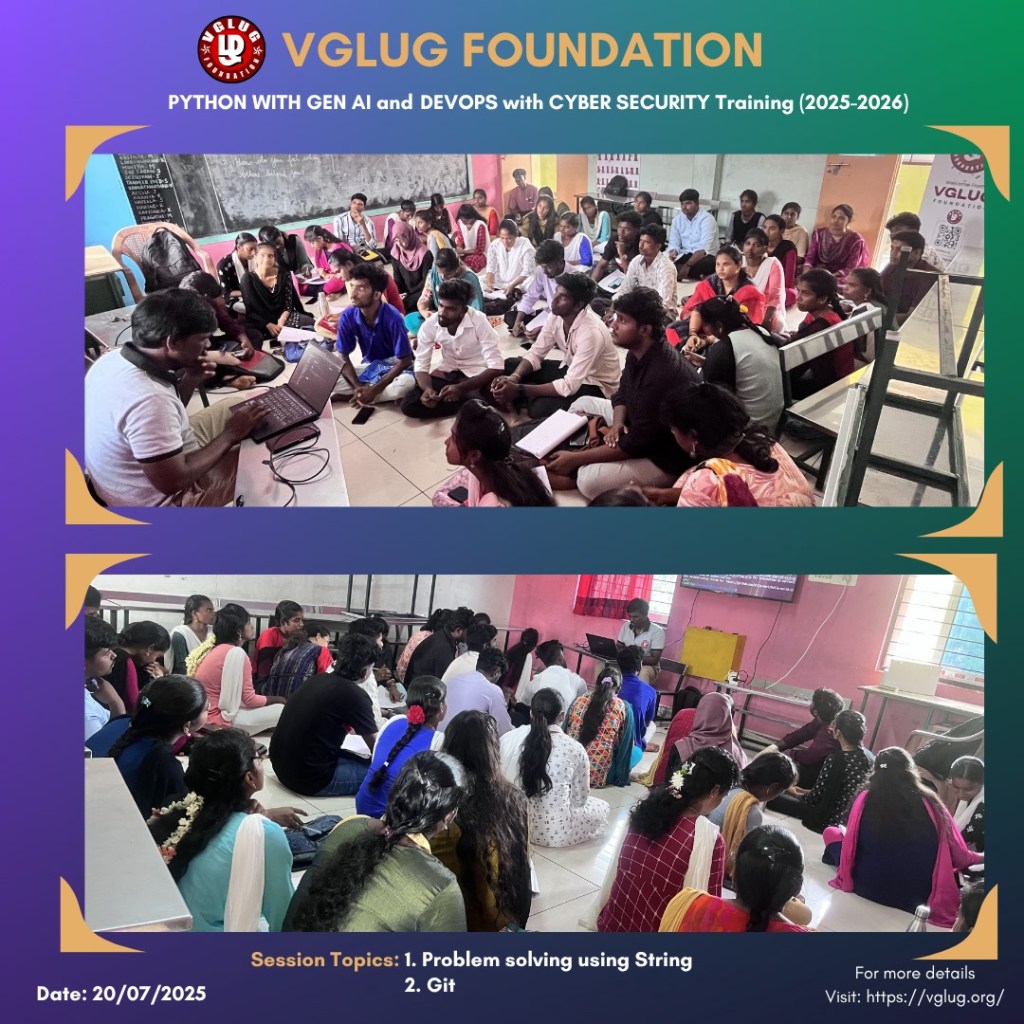
Session 1: Problem Solving Using String – Kowsalya & Dilip
This weekend’s VGLUG student meetup centered around a key programming skill: Problem Solving Using Strings. The session was designed to strengthen logical thinking and improve Python coding skills through practical, hands-on activities.
Participants were divided into Multiple teams, each given a unique string-based logic problem. These problems were carefully curated to apply concepts of looping — including for, while, and nested loops — to solve real-time challenges involving strings.
Each team worked collaboratively, and by the end of the session, all teams successfully implemented and explained their logic. Two students stood out by confidently presenting their solutions in front of everyone. They not only walked through their approach but also engaged in a Q&A session, making the learning experience truly interactive and peer-driven.
The session reflected the power of learning through problem-solving, discussion, and teamwork.
Session 2: Git – Mathusoothanan & Dilip
In this weekend’s VGLUG session, students were introduced to the basics of Git and GitHub.
Everyone created their own GitHub accounts and learned how to initialize and manage repositories.
They practiced key commands like git init, add, commit, and push.
Each student tried pushing their own code to a personal repository.
It was a hands-on session that built confidence in version control and collaboration.
What is Git?
🔹 Git is a version control system.
🔹 It helps developers track changes in their code and collaborate with others.
🔹 Git was created by Linus Torvalds (creator of Linux) in 2005.
Why Use Git?
| Problem Without Git | Solution With Git |
|---|---|
| Accidentally deleting code | Git lets you go back to old version |
| Team members overwrite changes | Git lets everyone work together safely |
| Confusion over file versions | Git tracks every change and update |
Basic Git Commands:
| Command | Meaning |
|---|---|
git init | Start a new Git project |
git status | Check the current state |
git add filename | Stage file changes |
git commit -m "message" | Save the changes with a message |
git log | View previous commits |
git clone URL | Copy a remote project to local |
git push | Upload your changes |
git pull | Download latest changes from others |
Git Workflow (Simple Steps)
git init → Start a project
git add → Stage the changes
git commit → Save the changes
git push → Send to GitHub or GitLab
Python With GenAI – Linux Torvalds Team & Grace Hopper Team
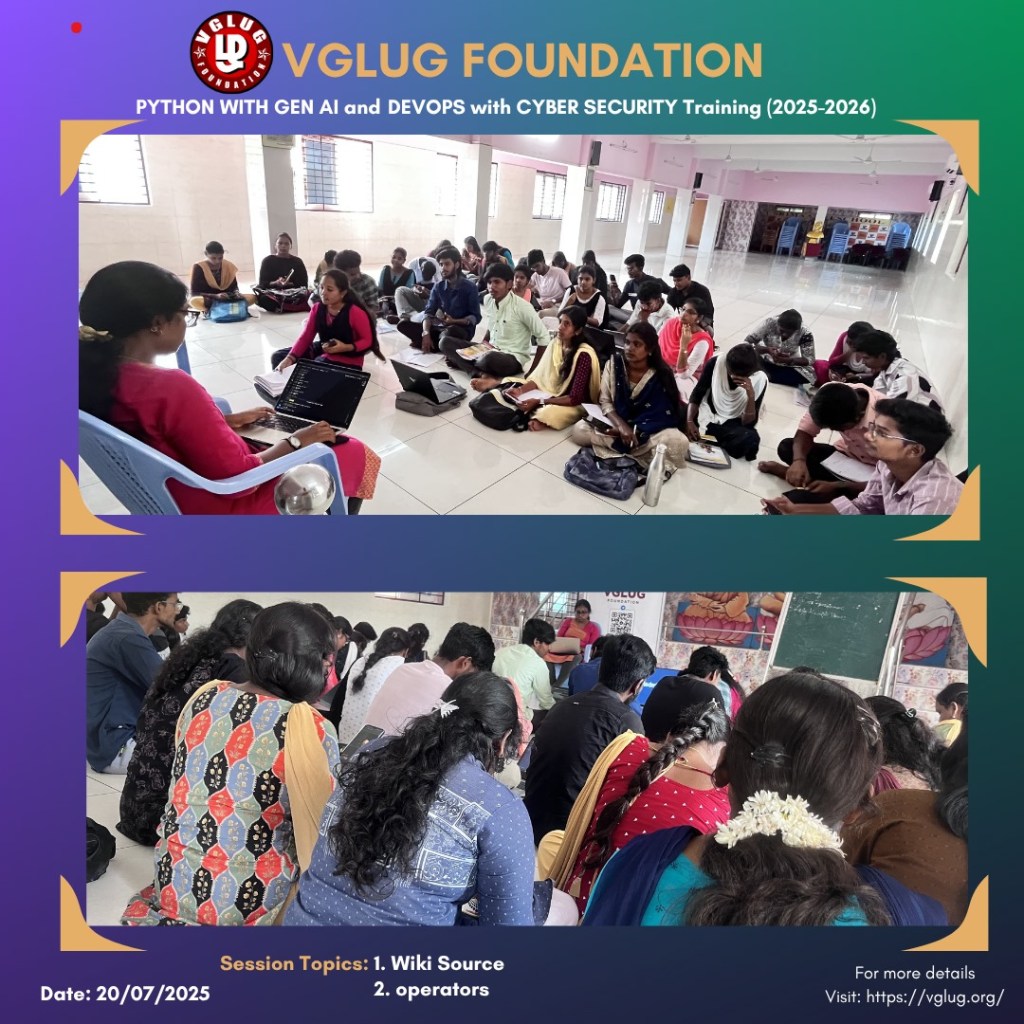
Session 1: Operators – Vijayalakshmi & Deepak
What are Operators in Python?
Operators are symbols or keywords used to perform operations on variables and values.
Example: +, -, *, /, ==,
1. Arithmetic Operators
| Operator | Description | Example |
|---|---|---|
+ | Addition | 5 + 2 = 7 |
- | Subtraction | 5 - 2 = 3 |
* | Multiplication | 5 * 2 = 10 |
/ | Division | 5 / 2 = 2.5 |
// | Floor Division | 5 // 2 = 2 |
% | Modulus (remainder) | 5 % 2 = 1 |
** | Exponentiation | 2 ** 3 = 8 |
2. Assignment Operators
| Operator | Meaning | Example |
|---|---|---|
= | Assign | x = 5 |
+= | Add and assign | x += 2 → x = x + 2 |
-= | Subtract and assign | x -= 2 |
*= | Multiply and assign | x *= 2 |
/= | Divide and assign | x /= 2 |
3. Comparison (Relational) Operators
| Operator | Description | Example |
|---|---|---|
== | Equal to | 5 == 5 → True |
!= | Not equal to | 5 != 3 → True |
> | Greater than | 5 > 3 → True |
< | Less than | 5 < 3 → False |
>= | Greater or equal | 5 >= 5 → True |
<= | Less or equal | 5 <= 4 → False |
4. Logical Operators
| Operator | Description | Example |
|---|---|---|
and | True if both are True | True and True → True |
or | True if one is True | True or False → True |
not | Inverts condition | not True → False |
5. Bitwise Operators (used for binary numbers)
| Operator | Description |
|---|---|
& | AND |
| ` | ` |
^ | XOR |
~ | NOT |
<< | Left shift |
>> | Right shift |
6. Identity Operators
| Operator | Example |
|---|---|
is | x is y |
is not | x is not y |
Session 2: Wikisource – Vasanth
What is Wikisource?
- Wikisource is a project that collects and shares free, editable, and reliable texts in many languages.
- It includes books, poems, speeches, historical documents, religious texts, and more.
- All content is in the public domain or under a free license, so anyone can use, share, and even edit the texts.
- It supports multiple languages, including Tamil (ta.wikisource.org) for Tamil literary works.
What Kind of Content Is Found on Wikisource?
- Classic literature (Tamil, English, and many other languages)
- Speeches by freedom fighters, politicians, thinkers
- Constitutional and legal documents
- Letters, autobiographies, translations, etc.
Why Is Wikisource Important?
- Preserves knowledge: Keeps old and rare texts alive digitally.
- Promotes free access: Everyone can read, copy, and reuse texts.
- Supports education: Students and researchers can access reliable texts easily.
- Encourages community participation: Anyone can help proofread and upload texts.
DevSecOps: Ada Lovelace Team
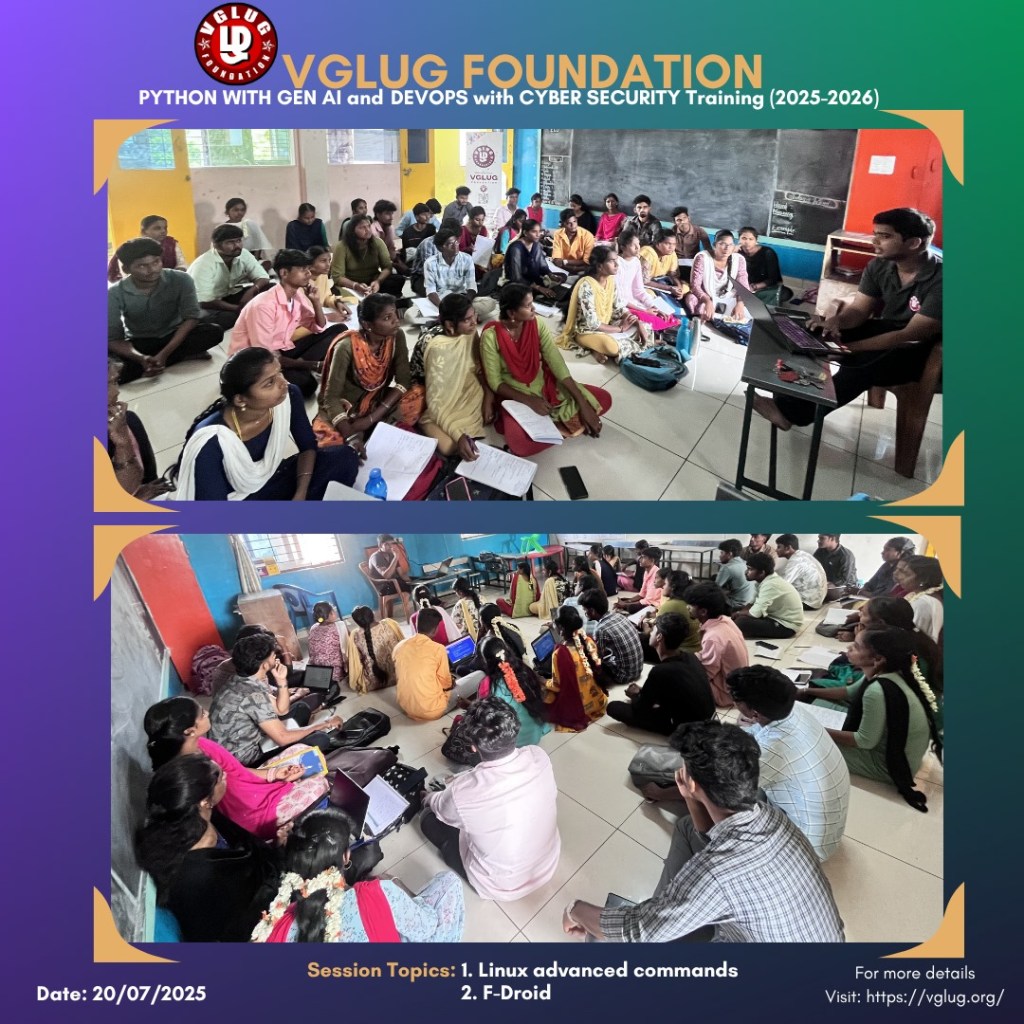
Session 1:Linux Advanced Commands – Vignesh
After learning basic Linux commands (like ls, cd, mkdir, rm, etc.), it’s important to explore more advanced Linux commands that help in managing processes, files, permissions, users, and networks. These are commonly used by developers, system admins, DevOps engineers, and power users.
Example commands:
File Permissions & Ownership
ls -l
chmod +x script.sh
chmod 755 file.txt
sudo chown user:group file.txt
Process Management
ps aux
top
kill -9
nice -n 10 command
renice -n 5
Archive & Compression
tar -cvf archive.tar folder/
tar -xvf archive.tar
gzip file.txt
gunzip file.txt.gz
Disk Usage & Space
df -h
du -sh folder/
Networking Commands
ip a
ping google.com
netstat -tuln
Package Management (Debian/Ubuntu)
sudo apt update
sudo apt upgrade
sudo apt install package-name
sudo apt remove package-name
File Searching
find / -name “*.pdf”
find . -mtime -1
grep “search_text” *.txt
User Management
sudo adduser username
sudo deluser username
su – username
Combine Commands
mkdir test && cd test
command1 || echo “Failed”
cd folder; ls; pwd
Bonus
history
alias ll=’ls -la’
crontab -e
man grep
Session 2: F-Droid – Mathusoothanan
- In this weekend’s VGLUG session, students were introduced to F-Droid, the free and open-source app store.
- They explored how it works differently from the Play Store — focusing only on FOSS (Free and Open Source Software) apps.
Each student installed the F-Droid app and browsed privacy-respecting alternatives. - They discussed how F-Droid supports user freedom and data safety.
It was an eye-opening session on digital rights and ethical tech choices.
- F-Droid is a community-driven app store focused only on Free and Open Source Software (FOSS).
- Unlike Google Play Store, F-Droid doesn’t track users or collect personal data.
- All apps available on F-Droid are free to download, use, and modify — with source code openly available.
Students explored FOSS alternatives for commonly used apps like:
- Simple Gallery (instead of Google Photos)
- NewPipe (instead of YouTube)
- K-9 Mail (instead of Gmail)
- Aegis Authenticator (instead of Google Authenticator)
- The session also covered how F-Droid builds transparency and trust by verifying apps using reproducible builds.
- Students learned how to safely install the F-Droid APK and enable unknown sources on Android.
- Discussion included how F-Droid can help people avoid ads, trackers, and proprietary restrictions.
DevSecOps: Bob Thomas Team
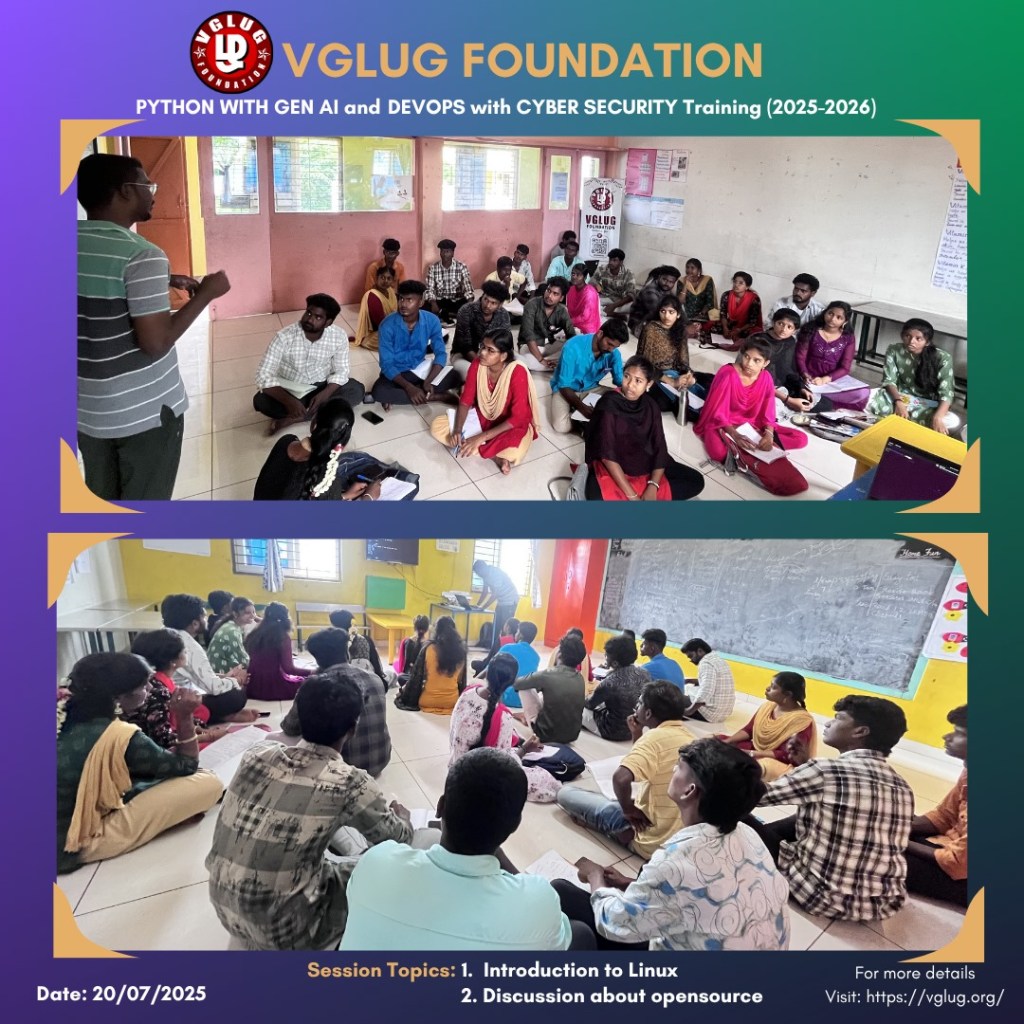
Session 1:Introduction to Linux- Loganathan
- This weekend’s VGLUG session gave students a basic introduction to Linux and its importance in today’s tech world.
- They learned how Linux is open-source, secure, and widely used in servers, coding, and ethical hacking.
- A demo on basic terminal commands like
ls,cd,pwd, andmkdirsparked curiosity. - Students explored the Ubuntu interface and understood the concept of file systems.
- It was an eye-opening session that kickstarted their journey into the world of Free and Open Source Software.
Session 2: Discussion about opensource- Vignesh
students had an open discussion about the importance of Free and Open Source Software (FOSS).
They explored how open source gives freedom to use, modify, and share software without restrictions.
Real-life examples like Linux, Firefox, VLC, and Wikipedia were shared.
The session helped students understand the community-driven nature of open source development.
It was a thoughtful and inspiring day that built awareness of tech freedom and collaboration.
INFORMATION:
We’re excited to share that the National Law School of India University (NLSIU) has conducted a case study on the impact of Free and Open Source Software (FOSS) and FOSS communities in India. We are honored that the VGLUG Foundation has been featured for our meaningful contributions to FOSS awareness, development, and community building.
https://www.getmyebook.in/book/560
Special thanks to the VGLUG volunteers —Vasanth, Kowsalya, Dilip, Loganathan, Deepak,Vignesh ,Mathusoothanan and Vijayalakshmi — for their dedicated support and commitment to making these training sessions successful.

 VGLUG Foundation