
VGLUG is dedicated to empowering rural college students through technology education.
As part of this initiative, we conduct weekly training sessions on Python With GenAI and DevSecOps..
Due to the large number of participants, the training is organized into six teams:
- Python & GenAI – Linus Torvalds(Team 1) & Grace Hopper(Team 2): Assigned to Engineering students
- Python & GenAI – Richard Stallman(Team 1) & Aron Swatz (Team 2): Assigned to Arts and Science students
- DevSecOps – Ada Lovelace (Arts) & Bob Thomas (Engg): Comprising both Engineering and Arts students
These sessions focus on practical knowledge of Python, GenAI, DevSecOps, free and open-source tools, and also include social awareness and community engagement activities.
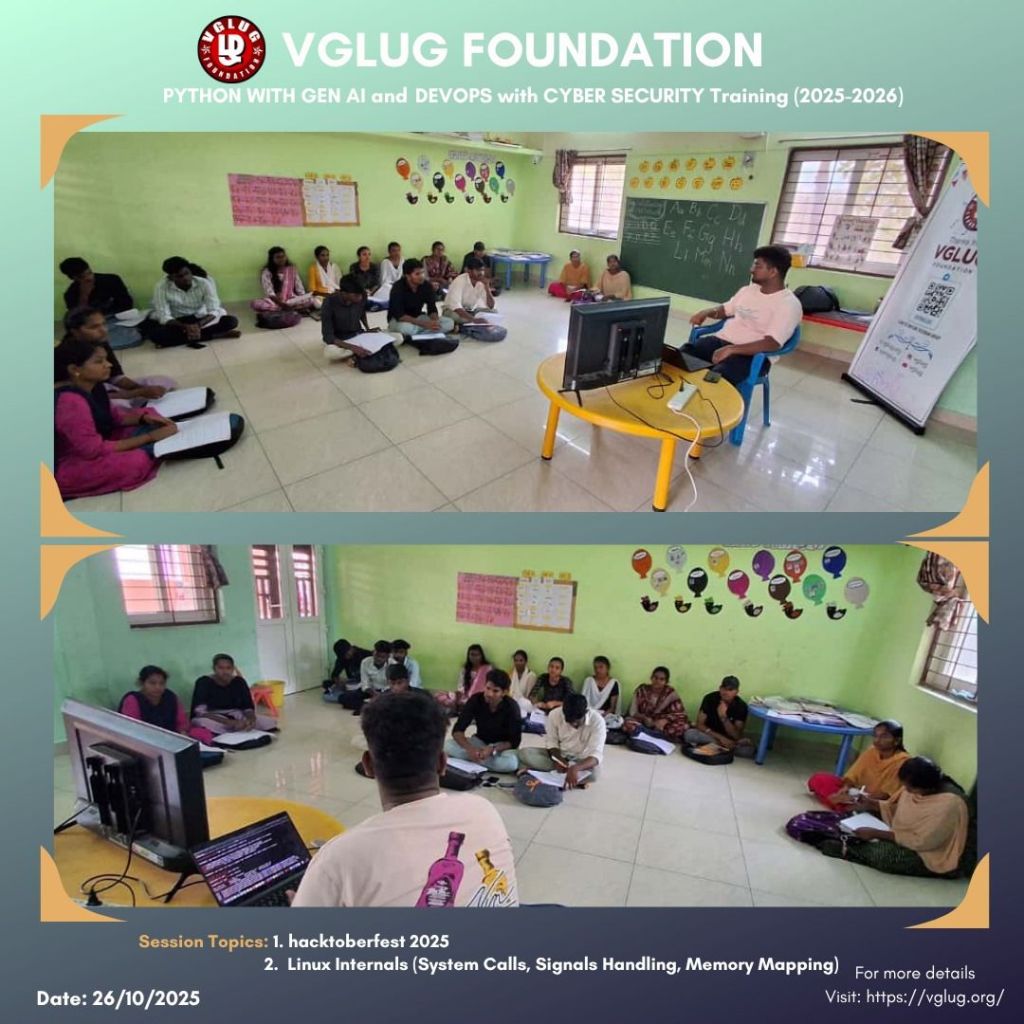
Python With GenAI Training – 20’th Week Recap
Date: 26th October 2025 (Sunday)
Time: 9:30 AM to 1:00 PM
Venue:
VGLUG Foundation
SRIMAA PRESCHOOL
Landmark: Opposite to BSNL Exchange
Villupuram 605602
Minutes of the Meeting
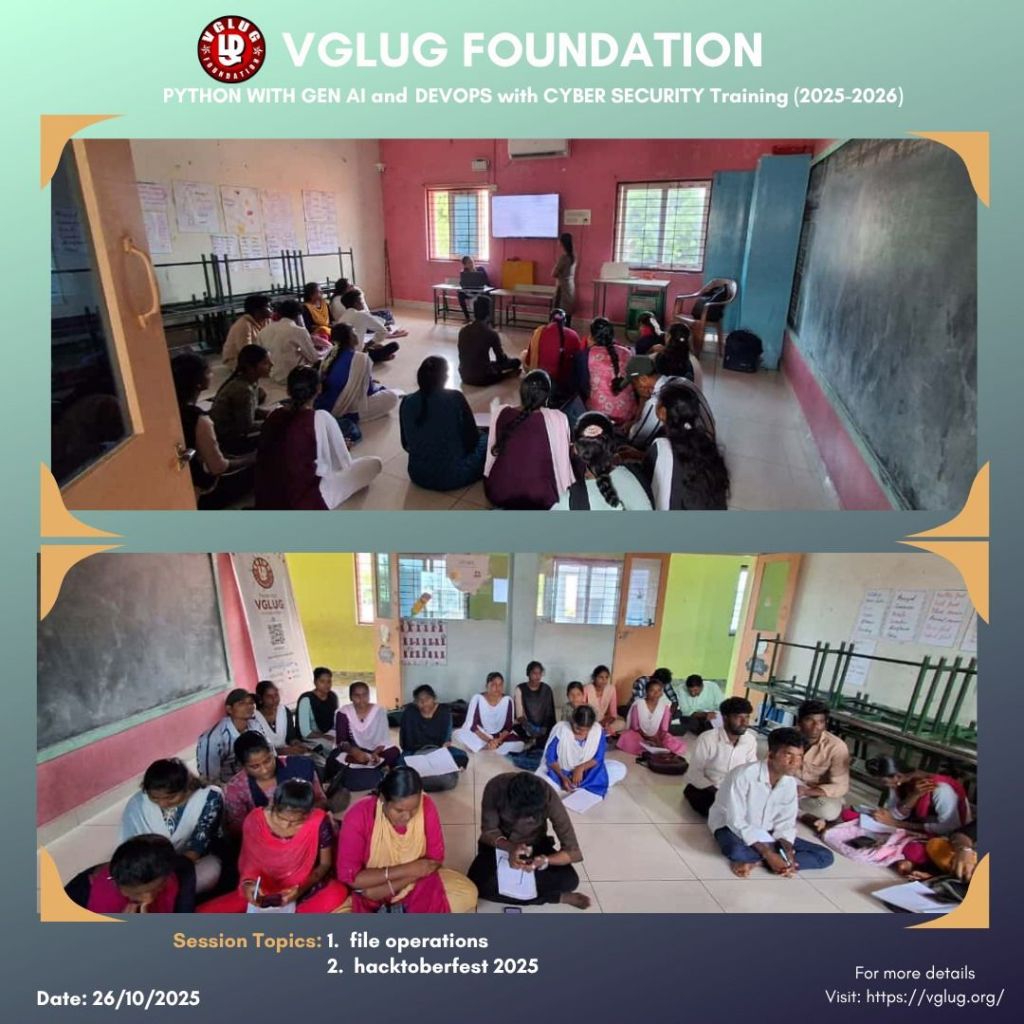
Python With GenAI – Richard Stallman and Aron Swatz(Arts) :
Session 1: File operations – Vasanth & Kowsalya
What is a File? :
A file is a place where we store data permanently.
There are two main types of files:
Text files (.txt, .csv, .log, etc.)
Binary files (like .jpg, .png, .exe, etc.)
Examples:
file = open(“sample.txt”, “r”) # ‘r’ means read mode
| Mode | Meaning | Description |
|---|---|---|
'r' | Read | Opens file for reading (default) |
'w' | Write | Overwrites file or creates new one |
'a' | Append | Adds data at the end of the file |
'r+' | Read & Write | Allows both reading and writing |
Write File:
with open(“demo.txt”, “r”) as f:
print(f.read())
Session 2: Hacktoberfest 2025 – Mathusoothanan & Hariharan
This week’s session focused on Hacktoberfest 2025 — a global celebration of open-source contributions!
Our students actively participated throughout the week, exploring GitHub, learning how to contribute, and submitting pull requests to various open-source repositories.
We’re proud to share that many students made 2–3 pull requests in a day, showing remarkable enthusiasm and teamwork. It’s truly inspiring to see them engaging with the open-source community and contributing to real-world projects.
We introduced this new topic and students showed great interest. They opened up, shared their own reading experiences, and connected the benefits to their daily life, making the discussion lively and inspiring.
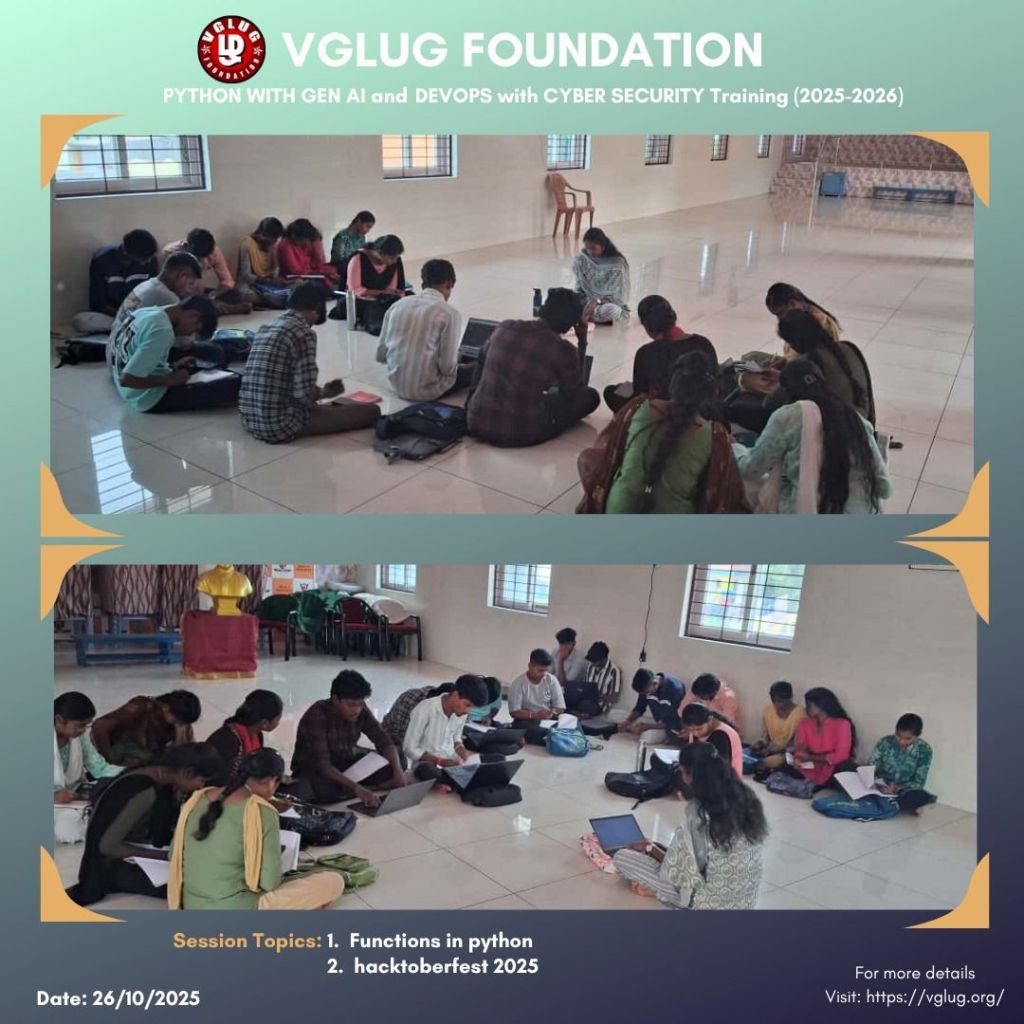
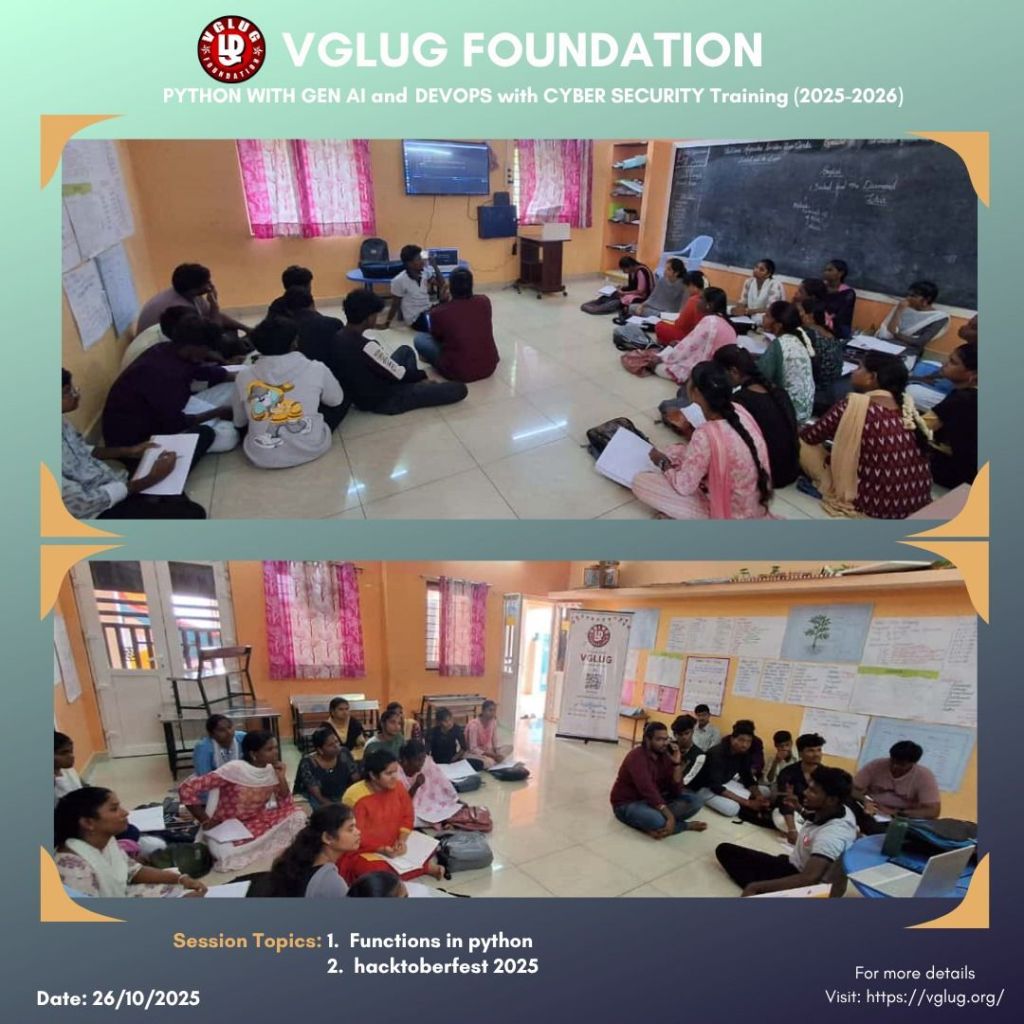
Python With GenAI – Linux Torvalds Team & Grace Hopper Team
Session 1: Functions in Python – Senkathir & Kanimozhi
Functions are one of the most important building blocks in Python.
They help you organize your code, avoid repetition, and make programs easier to understand.
What is a Function?
A function is a block of code that runs only when it is called.
You can pass data into a function and get a result back.
Example 1: Simple Function
def greet():
print(“Welcome to VGLUG Python Session!”)
greet()
# Output: Welcome to VGLUG Python Session!
Example 2: Function with Parameters
def greet_student(name):
print(“Hello”, name, “- Keep learning with VGLUG!”)
greet_student(“kavitha”)
# Output: Hello Kavitha- Keep learning with VGLUG!
Example 3: Function with Return Value:
def total_contributors(students, mentors):
return students + mentors
print(“Total contributors:”, total_contributors(25, 5))
# Output: Total contributors: 30
Session 2: Hacktoberfest 2025 – Deepak & Dilip
This week’s session focused on Hacktoberfest 2025 — a global celebration of open-source contributions!
Our students actively participated throughout the week, exploring GitHub, learning how to contribute, and submitting pull requests to various open-source repositories.
We’re proud to share that many students made 2–3 pull requests in a day, showing remarkable enthusiasm and teamwork. It’s truly inspiring to see them engaging with the open-source community and contributing to real-world projects.
DevSecOps: Ada Lovelace Team & Bob Thomas Team
Session 1:Linux Internals (System Calls, Signals Handling, Memory Mapping) – Loganathan
This week’s VGLUG technical session focused on Linux Internals, covering key topics like System Calls, Signal Handling, and Memory Mapping.
Students showed great interest in exploring how the Linux operating system works behind the scenes. They actively practiced commands, wrote C programs, and experimented with real-time examples to understand how the kernel interacts with user-level applications.
System Calls:
System calls are the bridge between user space and kernel space.
They allow user programs to request services from the operating system — like creating files, reading data, or managing processes.
#include
#include
int main() {
write(1, “Hello from System Call!\n”, 25);
return 0;
}
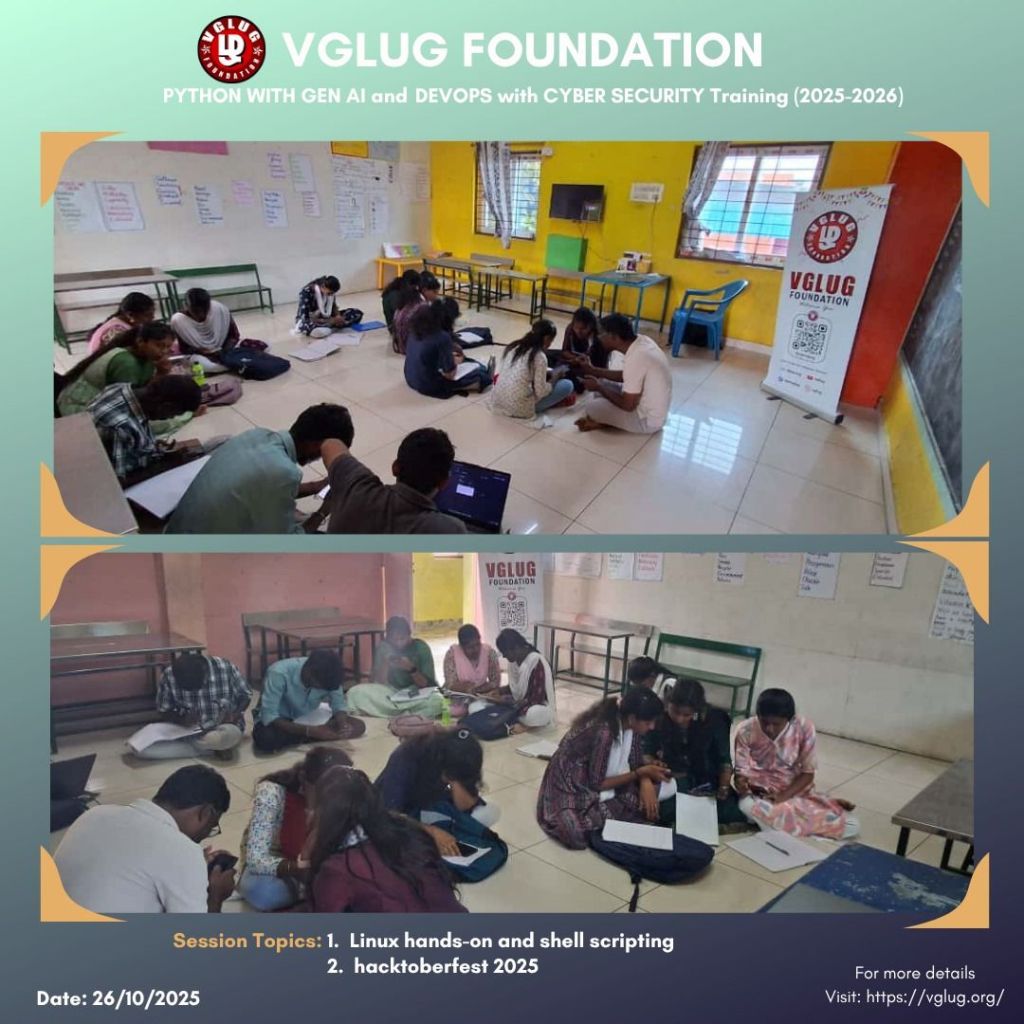
Session 1 : Linux hands-on and shell scripting(wildcards and regex) – Loganathan
This week’s VGLUG technical session was an exciting hands-on experience on Linux shell scripting, where students explored Wildcards and Regular Expressions (Regex).
students practiced real-time Linux commands and learned how scripting can automate repetitive tasks efficiently. The session helped them build a strong foundation in writing and testing shell scripts
Wildcards in Linux:
Wildcards are special characters that help match file names or patterns in the Linux terminal. They make searching and file management easier and faster.
ls *.txt # Lists all .txt files
ls a?b* # Matches files starting with ‘a’, any one character, then ‘b’
rm file[1-3].log # Removes file1.log, file2.log, and file3.log
Regular Expressions (Regex)
Regular Expressions are used to search and filter text using patterns.
They are extremely powerful in Linux commands like grep, sed, and awk
grep “^VGLUG” events.txt # Finds lines starting with ‘VGLUG’
grep “[0-9]” report.txt # Finds lines containing any digit
grep “log$” filenames.txt # Finds lines ending with ‘log’
Session 2: Hacktoberfest 2025 – Loganathan & Vignesh
This week’s session focused on Hacktoberfest 2025 — a global celebration of open-source contributions!
Our students actively participated throughout the week, exploring GitHub, learning how to contribute, and submitting pull requests to various open-source repositories.
We’re proud to share that many students made 2–3 pull requests in a day, showing remarkable enthusiasm and teamwork. It’s truly inspiring to see them engaging with the open-source community and contributing to real-world projects.
Special thanks to the VGLUG volunteers —
Vasanthavel, Dilip, Loganathan, Deepak, Kanimozhi, Kowsalya, Senkathir, Hariharan, Mathusoothan, and Kowsalya — for their dedicated support and commitment
to make these training sessions successful.

 VGLUG Foundation