
Date: 15th December 2024 (Sunday)
Time: 9:30 AM to 1:00 PM
Venue:
VGLUG Foundation
SRIMAA PRESCHOOL (Gov Recognized)
Landmark: Opposite to BSNL Exchange
Villupuram 605602.
Minutes of meeting
Data Analytics with Python Team 1(Arts & Science)
Topics:
session 1:
Network in Iot – Mathusoothanan
session 2:
File Handling – Kowsalya
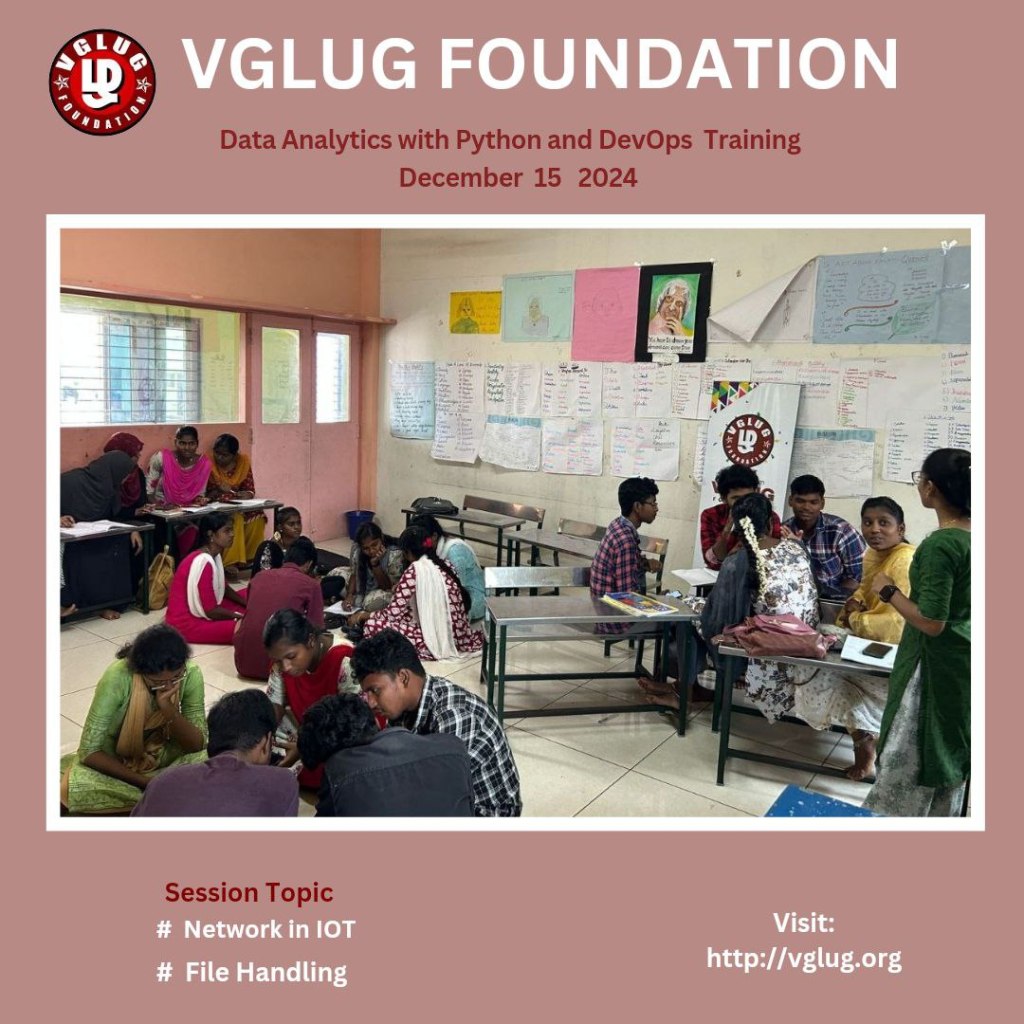
Network in Iot
Mathusoothanan has handled this session. He explained Networking in IoT involves the technologies that enable communication among devices. Embedded with sensors and actuators, these devices use networking protocols to send data to cloud servers, edge devices, or other endpoints. Efficient networking ensures reliability, scalability, and security.
Components of IoT Networks
- IoT Devices
- Sensors, actuators, and microcontrollers.
- Gateways
- Connect IoT devices to broader networks.
- Network Infrastructure
- Routers, switches, and access points.
- Cloud and Edge Servers
- Cloud servers store data; edge servers process data close to devices.
Future Trends in IoT Networking
- 5G Networks – High-speed, low-latency communication.
- Edge Computing – Faster processing closer to devices.
- AI and Machine Learning – Smarter network management.
- IPv6 Adoption – More connected devices.
- SDN – Flexible and programmable networks.
File Handling
Kowsalya has handled this session. She explained File handling is a crucial concept in programming that enables developers to work with files and directories, including creating, reading, writing, and deleting files
Common File Operations
- Creating Files
- Using commands or functions to generate a new file.
- Reading Files
- Extracting and processing data from existing files.
- Writing Files
- Adding data to a file, either appending or overwriting content.
- Deleting Files
- Removing files that are no longer needed.
Example python code:
# Writing to a file
with open('example.txt', 'w') as file:
    file.write('Hello, File Handling!')
# Reading from a file
with open('example.txt', 'r') as file:
    content = file.read()
    print(content)
Data Analytics with Python Team 2(Arts & Science)
Topics:
session 1:
File Handling – Kowsalya
session 2:
Network in Iot – Mathusoothanan
File Handling
Kowsalya has handled this session. She explained File handling refers to the process of performing operations on files. It is essential for storing data persistently, reading data from external sources, and managing files programmatically. Most programming languages offer libraries or modules to handle files efficiently.
File Handling Modes
- Read Mode (
r)- Opens a file for reading; file must exist.
- Write Mode (
w)- Opens a file for writing; creates a file if it does not exist or truncates if it does.
- Append Mode (
a)- Opens a file for appending data; does not erase existing content.
- Read and Write Mode (
r+,w+,a+)- Combines reading and writing operations.
Network in Iot
Mathusoothanan has handled this session. He explained Networking in IoT involves the technologies that enable communication among devices. Embedded with sensors and actuators, these devices use networking protocols to send data to cloud servers, edge devices, or other endpoints. Efficient networking ensures reliability, scalability, and security.
Future Trends in IoT Networking
- 5G Networks – High-speed, low-latency communication.
- Edge Computing – Faster processing closer to devices.
- AI and Machine Learning – Smarter network management.
- IPv6 Adoption – More connected devices.
- SDN – Flexible and programmable networks.
Data Analytics with Python Team 1(Engineering)
Topics:
session 1:
Regex & Problem solving – kanimozhi
session 2:
Google Dorking – Vigneshwaran
Regex & Problem solving
kanimozhi has handled this session. She explained Regular Expressions (Regex) are powerful tools in programming used for pattern matching and text processing. They provide a concise and flexible way to identify strings of interest, making them indispensable in problem-solving scenarios such as validation, parsing, and data manipulation.
Google Dorking
Vigneshwaran has handled this session. He explained Google Dorking, also known as Google Hacking, is a technique that leverages advanced search operators to find information not readily visible on websites. Originally designed for improving search efficiency, it is often used by cybersecurity professionals to discover vulnerabilities, sensitive data, and misconfigurations online.
Google Dorking involves using specific queries in Google Search to uncover hidden data, such as:
- Confidential files
- Vulnerable directories
- Login pages
- Server configurations
This technique is particularly useful for ethical hacking and penetration testing, helping to identify potential security issues.
Data Analytics with Python Team 2(Engineering)
Topics:
session 1:
Google Dorking – Dilip
session 2:
Regex & Problem solving – Kanimozhi
Regex & Problem solving
Dilip has handled this session. He explained Google Dorking, also known as Google Hacking, is a technique that leverages advanced search operators to find information not readily visible on websites. Originally designed for improving search efficiency, it is often used by cybersecurity professionals to discover vulnerabilities, sensitive data, and misconfigurations online.
Google Dorking
kanimozhi has handled this session. She explained Regular Expressions (Regex) are powerful tools in programming used for pattern matching and text processing. They provide a concise and flexible way to identify strings of interest, making them indispensable in problem-solving scenarios such as validation, parsing, and data manipulation.
Devops
Topics:
session 1:
Puppet Architecture Configuration – Vignesh
session 2:
Open Hardware and its application- senkathir
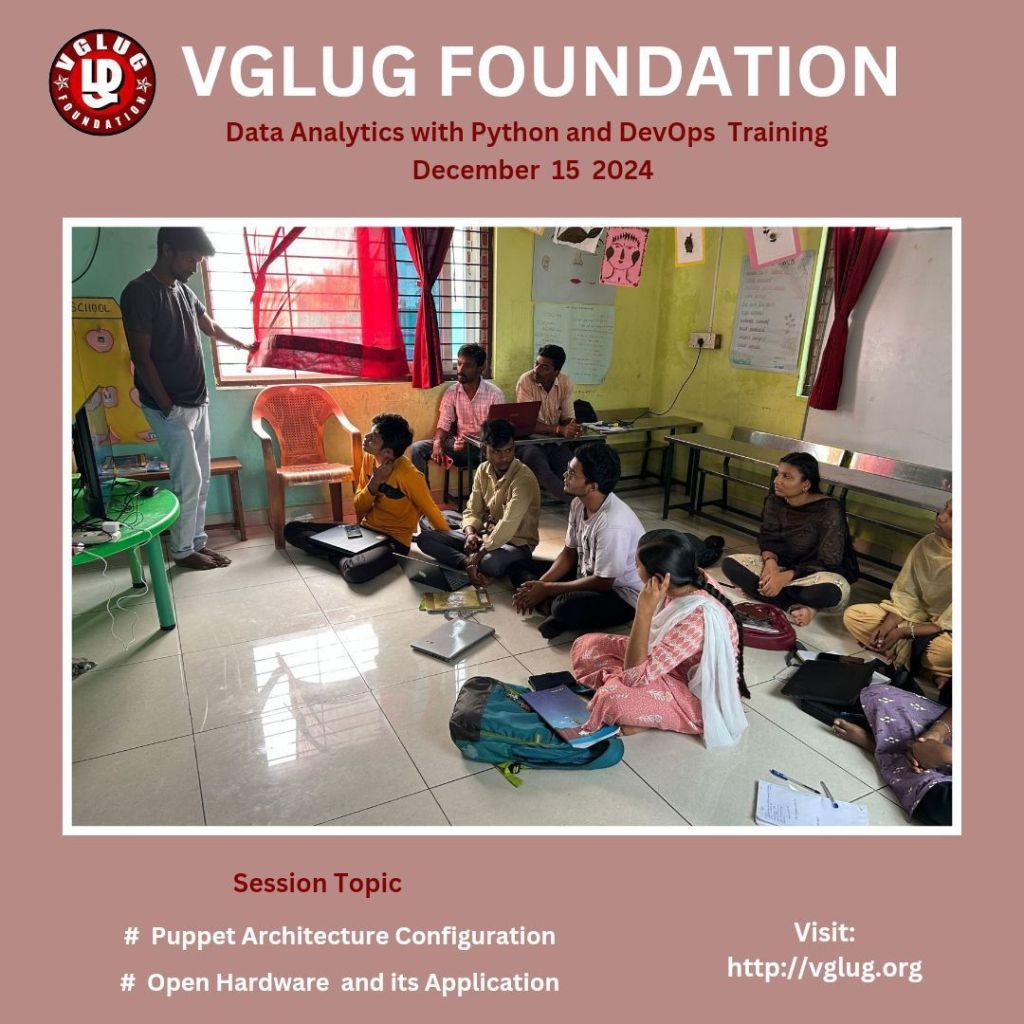
Puppet Architecture Configuration
Vignesh has handled this session. He explained Puppet is an open-source configuration management tool designed to automate the management and deployment of infrastructure. It enables system administrators to define system configurations declaratively, ensuring consistency, scalability, and ease of maintenance.
Puppet Architecture Overview
The Puppet architecture follows a client-server model consisting of:
- Puppet Master
- The central server that stores configuration manifests.
- Distributes configurations to agents.
- Puppet Agent
- A software agent installed on client nodes.
- Communicates with the Puppet Master to apply configurations.
- Puppet DB
- A database to store information about managed nodes and their states.
- Facter
- A utility that gathers system information such as OS, memory, and IP address.
- This data is used in configuration decisions.
- Hiera
- A key-value lookup tool for configuration data management.
- Separates data from code to enhance modularity.
Open Hardware and its application
senkathir has handled this session. He explained Open hardware is transforming industries by promoting accessibility, collaboration, and innovation. From education to healthcare, its applications are vast and impactful. By embracing open hardware, we can build a more inclusive and sustainable technological future.
Applications of Open Hardware
Education and Research
Healthcare
Agriculture
Sustainable Development
IoT and Smart Devices
Here, we attached tbe meetup clicks,
Arts team1
Arts Team2

Engineering Team2

Devops Team
Thanking you
by
VGLUG Volunteer

 VGLUG Foundation