VGLUG is dedicated to empowering rural college students through technology education.
As part of this initiative, we conduct weekly training sessions on Python With AgenticAI.
- Python & AgenticAI – Arts(Team 1) & Arts(Team 2) & Arts (Team 3)
- Python & AgenticAI – Engg(Team 1) & Engg(Team 2) & Engg(Team 3)
These sessions focus on practical knowledge of Python, AgenticAI, free and open-source tools, and also include social awareness and community engagement activities.
Python With AgenticAI Training Session – 11’th Week Recap
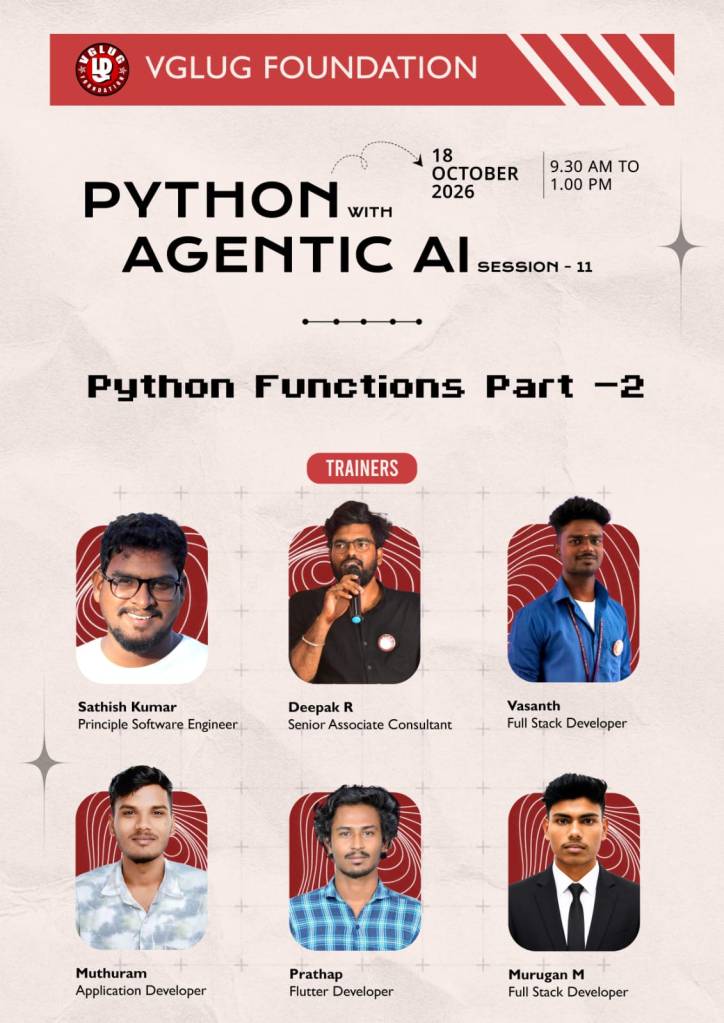
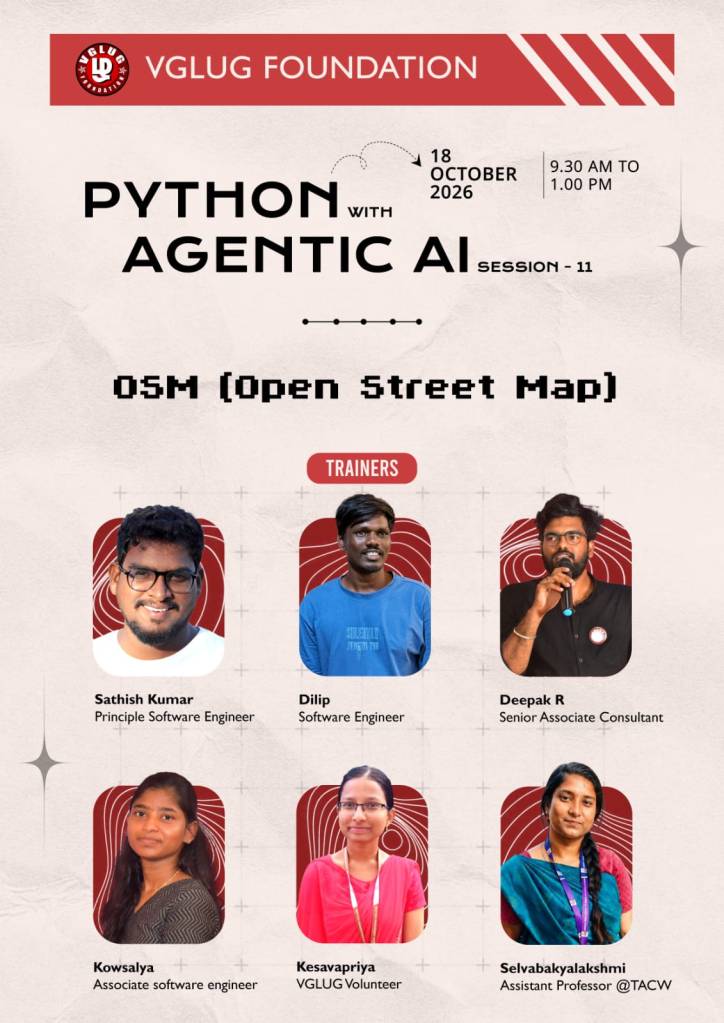
Session Taken : Kowsalya, Sathish, Dilip, Deepak, Kesavapriya, Vijayalakshmi, Prathap, Murugan,Vasanth,Muthuram
Session 1: – Python Functions part -2
Session 1: – OSM
Date: 18-10-2026 (Sunday)
Time: 9:30 AM to 1:00 PM
Minutes of the Meeting
Python With AgenticAI – (Arts Team1,Team2, Team3) & (Engg Team1,Team2, Team3)
Session 1: Python Functions:
Python Functions – Part 2: Advanced Concepts and Problem-Solving
Introduction
This week’s VGLUG Foundation session continued the learning journey of Python Functions. Building on the concepts covered in Part 1, students explored different types of function arguments, return values, variable scope, lambda functions, and recursion. The session emphasized practical implementation and problem-solving to help students apply these concepts to real-world programming challenges.
Topics Covered
Students learned about positional arguments, keyword arguments, default arguments, and variable-length arguments using *args and **kwargs. They also explored how the return statement passes results back to the calling code, how local and global variables work, and how lambda and recursive functions can solve specific problems.
Problem-Solving Examples
During the session, students worked on practical programming problems to improve their logical thinking and coding skills.
1. Find the Largest of Three Numbers
Students practised writing a function that accepts three numbers and returns the largest value.
def largest(a, b, c): return max(a, b, c)print(largest(10, 25, 15))
Output: 25
2. Calculate the Factorial of a Number
Students explored recursion by creating a function that calls itself to calculate the factorial of a number.
def factorial(n): if n == 0 or n == 1: return 1 return n * factorial(n - 1)print(factorial(5))
Output: 120
3. Calculate the Total Marks
Students used variable-length arguments with *args to calculate the total marks obtained across multiple subjects.
def total_marks(*marks): return sum(marks)print(total_marks(80, 90, 75, 85))
Output: 330
4. Check Whether a Number Is Even or Odd
Students practised using a lambda function to check whether a number is even or odd.
check = lambda n: "Even" if n % 2 == 0 else "Odd"print(check(7))
Output: Odd
5. Calculate the Final Price After a Discount
Students applied function parameters and return values to calculate the price of a product after a discount.
def final_price(price, discount=10): return price - (price * discount / 100)print(final_price(1000))print(final_price(1000, 20))
Output:
900.0800.0
These exercises helped students understand how different function concepts can be applied to solve programming problems efficiently.
Hands-on Learning and Student Participation
Students actively participated in coding exercises, tested their solutions, and explored different approaches to solving problems. The activities encouraged them to understand program logic, identify errors, and write reusable functions instead of repeating code.
Through collaborative learning and practical implementation, students strengthened their understanding of Python functions and improved their confidence in problem-solving.
Conclusion
Python Functions – Part 2 provided students with an opportunity to explore additional function concepts through practical examples and coding challenges. By applying arguments, return values, recursion, lambda functions, and default parameters, students developed a stronger foundation for writing structured and reusable Python programs.
VGLUG Foundation continues to encourage students to learn by doing, collaborate with peers, and build their technical skills through practical programming and Free and Open Source Software (FOSS) activities.
Session 2 :
OSM :
This week, we conducted an interactive session on OpenStreetMap (OSM), where we explored the world of open-source mapping and learned how digital maps are created, edited and updated through community contributions.
The session was a collaborative learning experience, with participants actively exploring OpenStreetMap and understanding its features through practical activities.
Highlights of the Session:
- Introduction to OpenStreetMap and its importance.
- How to search for and identify locations on the map.
- Understanding the OSM editing interface.
- Learning how to add and edit map features such as roads, buildings and places.
- Exploring how accurate mapping data can help local communities.
Rather than focusing only on theory, the session included hands-on activities. We explored different locations, discussed mapping challenges and learned how to make improvements to map data.
It was a great opportunity for everyone to share ideas, learn from one another and gain practical knowledge of digital mapping.
Special thanks to Kowsalya, Sathish, Dilip, Deepak, Selvabakyalakshmi, Prathap, Kesavapriya ,Muthuram ,Murugan,Vasanth,Prasanth for their support and contribution in making the Python Functions part -2 & OSM session successful.