VGLUG is dedicated to empowering rural college students through technology education.
As part of this initiative, we conduct weekly training sessions on Python With AgenticAI.
- Python & AgenticAI – Arts(Team 1) & Arts(Team 2) & Arts (Team 3)
- Python & AgenticAI – Engg(Team 1) & Engg(Team 2) & Engg(Team 3)
These sessions focus on practical knowledge of Python, AgenticAI, free and open-source tools, and also include social awareness and community engagement activities.
Python With AgenticAI Training Session – 8’th Week Recap
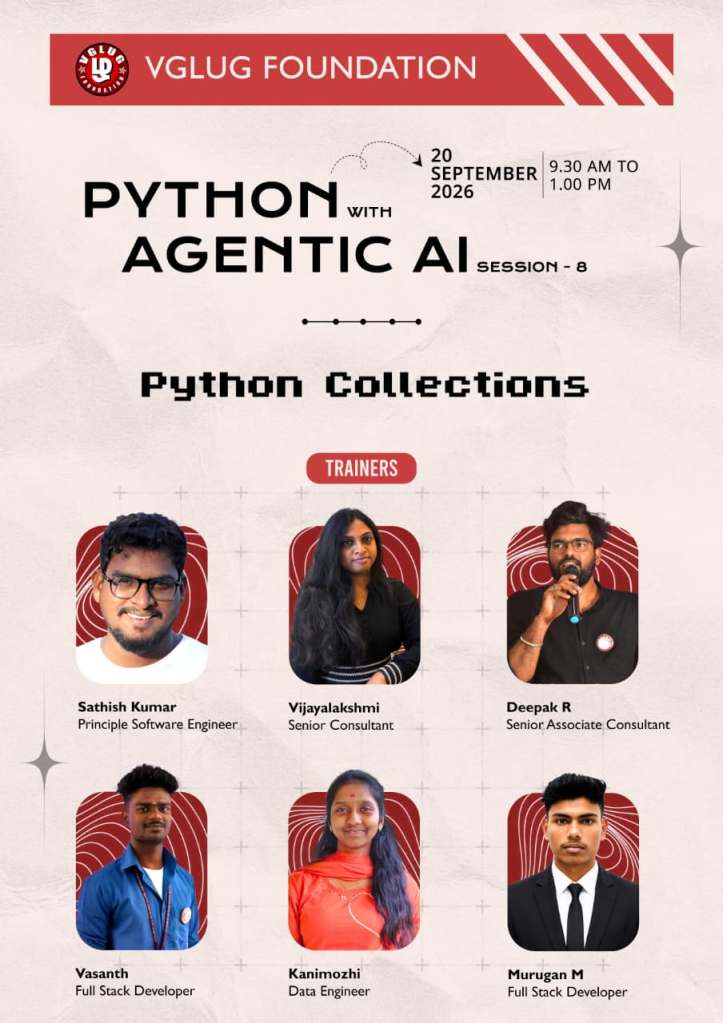
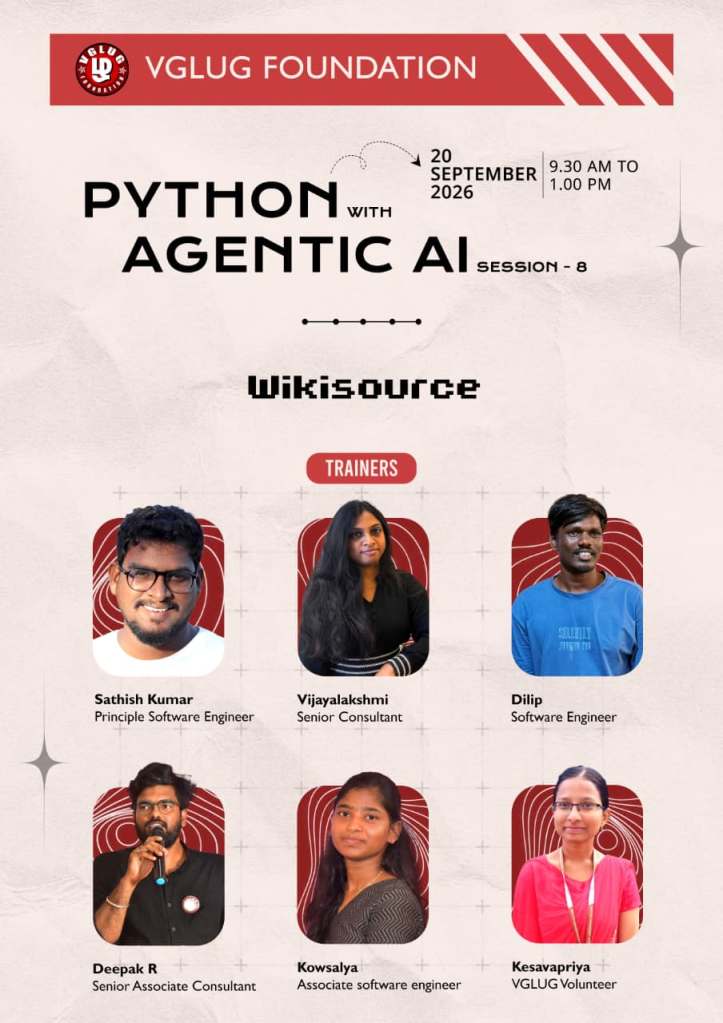
Session Taken : Kowsalya, Sathish, Dilip, Deepak, Kanimozhi , Vijayalakshmi, Prathap, Murugan, Vasanth
Session 1: – Python Collections
Session 1: – Wikisource
Date: 20-09-2026 (Sunday)
Time: 9:30 AM to 1:00 PM
Minutes of the Meeting
Python With AgenticAI – (Arts Team1,Team2, Team3) & (Engg Team1,Team2, Team3)
Session 1: Python Collections:
What are Collections?
A collection is used to store multiple values in a single variable.
Example:
student1 = “Arun”
student2 = “Priya”
student3 = “Kavi”
students = [“Arun”, “Priya”, “Kavi”]
Types:
- List
- Tuple
- Set
- Dictionary
What is a List?
A List stores multiple items in one variable.
Lists are:
- Ordered
- Changeable
- Allow duplicate values
- Written using
[ ]
Example:
students = ["Arun", "Priya", "Kavi"]print(students)o/p:['Arun', 'Priya', 'Kavi']
Access List Items:
Lists use index numbers.
Index starts from 0.
students = ["Arun", "Priya", "Kavi"]o/p:| Value | Index || ----- | ----: || Arun | 0 || Priya | 1 || Kavi | 2 |
List Methods:
students = [“Arun”, “Priya”, “Kavi”]
Add an item:
students.append(“Ravi”)
Insert at a position:
students.insert(1, "Meena")
Remove an item:
students.remove("Priya")
Remove using index:
students.pop(0)
Sort:
students.sort()
2. TUPLE
What is a Tuple?
A Tuple is similar to a list, but it cannot be changed after creation.
Tuples are:
- Ordered
- Immutable
- Allow duplicates
- Written using
( )
Example:
days = ("Monday", "Tuesday", "Wednesday")print(days)
| Feature | List | Tuple |
|---|---|---|
| Syntax | [ ] | ( ) |
| Ordered | Yes | Yes |
| Changeable | Yes | No |
| Duplicates | Yes | Yes |
| Example | ["A", "B"] | ("A", "B") |
3. SET
What is a Set?
A Set is a collection of unique values.
Sets are:
- Unordered
- Changeable
- Do not allow duplicates
- Written using
{ }
Example:
numbers = {1, 2, 3, 2, 1}print(numbers)
Output:
{1, 2, 3}
skills = {"Python", "Git", "Python"}
Output: {'Python', 'Git'} — duplicates are automatically removed.
What is a Dictionary in Python?
A Dictionary is a collection that stores data in key–value pairs.
Think of it like a real dictionary:
Word → Meaning
In Python:
student = {"name": "Kavi", "age": 20}
| Feature | List | Tuple | Set | Dictionary |
|---|---|---|---|---|
| Syntax | [ ] | ( ) | { } | {key: value} |
| Ordered | Yes | Yes | No | Yes* |
| Changeable | Yes | No | Yes | Yes |
| Duplicates | Allowed | Allowed | Not allowed | Keys: Not allowed |
| Indexing | Yes | Yes | No | No |
| Stores | Values | Values | Unique values | Key–Value pairs |
| Example | ["A", "B"] | ("A", "B") | {"A", "B"} | {"name": "A"} |
Session 2: Wikisource:
What is Wikisource?
Wikisource is a free online library of free-content and public-domain texts.
It contains digital versions of books, documents, poems, speeches, historical works and other texts.
| Wikipedia | Wikisource |
|---|---|
| Online encyclopedia | Online digital library |
| Contains articles | Contains original/public-domain texts |
| Provides information about topics | Provides the actual source text |
| Articles are written by contributors | Texts are digitized and proofread by contributors |
| Example: Article about a poet | Example: The poet’s book |
Today, each student will create a Wikisource account and make their first contribution by proofreading a page from an available text. You will compare the scanned page with the text provided on Wikisource, identify OCR or typing errors, correct them carefully, and save the page. This small contribution helps improve the accuracy and accessibility of digital texts, while also helping preserve books and documents for future readers.
Special thanks to Kowsalya, Sathish, Dilip, Deepak, Kanimozhi, and Vijayalakshmi, Selvabakyalakshmi, Murugan,Vasanth for their support and contribution in making the Python Collections & Wikisourcesession successful.